Quattr Leads AEO, SEO, and Content Rankings on G2 Spring 2026.
Quattr Leads AEO, SEO, and Content Rankings on G2 Spring 2026.

Many websites treat title tags and H1 headings as the same thing, but this small mistake can quietly impact your SEO performance. While they may seem similar, each serves a different purpose in helping search engines understand your content and guiding users on your page. In this guide, we’ll break down the difference between title tags and H1s, why both matter, and how optimizing them correctly can improve your rankings, visibility, and overall user experience.
6.
7.
8.
9.
10.
Title tags and H1 tags both help describe what your webpage is about, but they are not the same and serve different roles. Many website owners confuse them because they often look similar or are automatically set the same by content management systems.
The main difference comes down to where they appear and who they are meant for. A title tag shows up in search engine results and browser tabs, helping users decide whether to click, while the H1 tag appears on the page itself as the main heading.
You can think of the title tag as your first impression in search results. It needs to be clear, engaging, and optimized with keywords so it attracts clicks and tells search engines what your page is about.
On the other hand, the H1 tag is for users who have already landed on your page. It should clearly explain the content they are about to read and match their intent, improving readability and user experience.
Although title tags and H1 tags can sometimes be the same, they don’t always have to be. In many cases, slightly adjusting them helps you target keywords better in search while keeping the on-page heading more natural and user-friendly.
Understanding and using both correctly is important for SEO. When optimized well, they work together to improve your rankings, increase click-through rates, and create a better experience for your visitors.

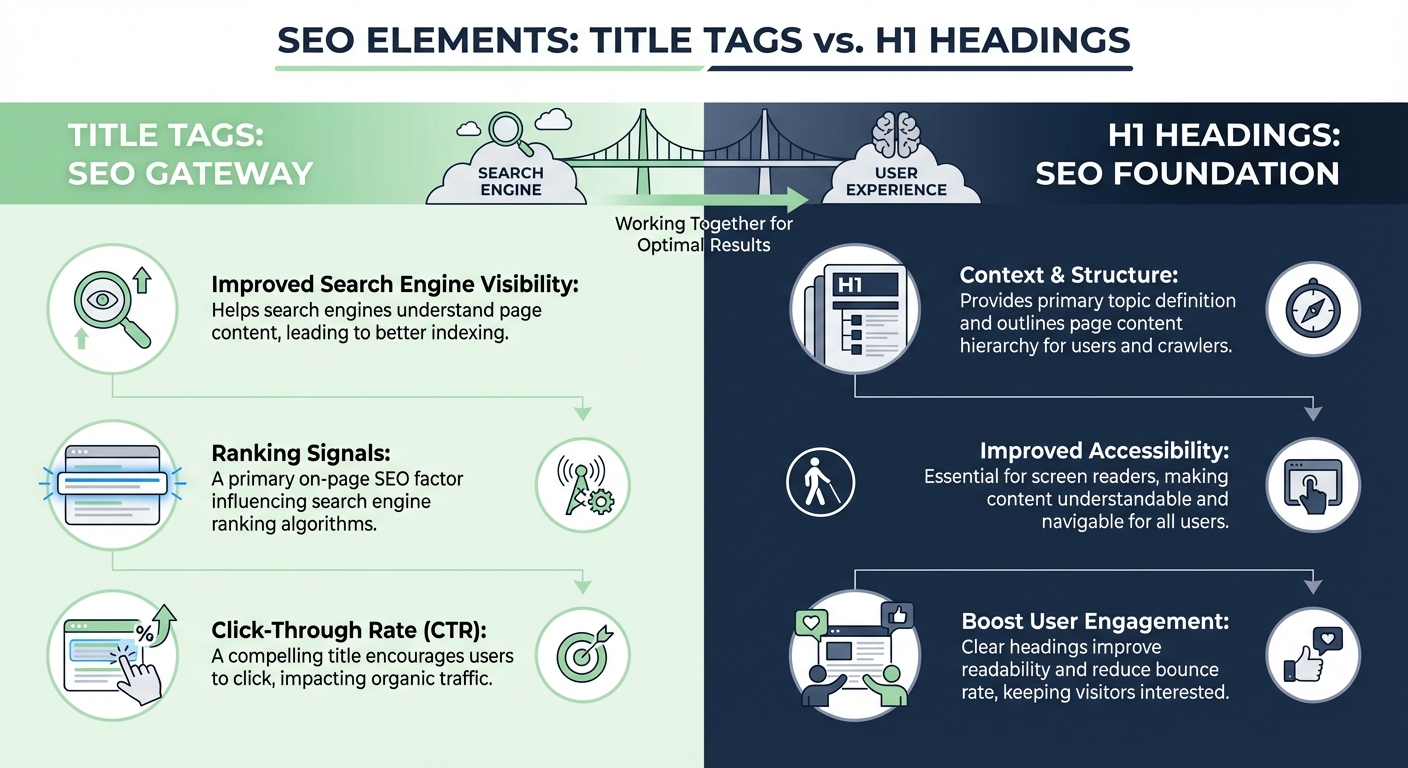
Title tags and H1 headings are important for SEO because they help search engines clearly understand what your page is about. The title tag gives context in search results, while the H1 reinforces the main topic on the page, making it easier for search engines to match your content with relevant queries.
They also play a major role in improving click-through rates and user engagement. A well-written title tag attracts users to click your link in search results, while a clear H1 reassures them they’ve landed on the right page, reducing bounce rates and improving overall performance.
Another key reason they matter is content structure and readability. H1 tags act as the main heading of a page and help organize information, making it easier for users to scan and understand the content quickly.
In addition, both elements contribute to a better user experience, which is increasingly important for SEO. Clear headings and relevant titles help users navigate content smoothly, and search engines consider user experience signals when ranking pages.
Title tags and H1s also support accessibility by helping screen readers and assistive technologies interpret the structure of a page. This ensures your content is usable for a wider audience while also aligning with modern SEO best practices.
Overall, when optimized together, title tags and H1 headings improve visibility, relevance, and usability. They work as a combined signal that strengthens your page’s chances of ranking higher and delivering a better experience to users.
The title tag and H1 heading are two crucial elements of on-page SEO. They both play a vital role in improving your search engine rankings and attracting more traffic to your website. Here are the best practices to optimize title tags and H1 headings:
Start your title and H1 with relevant keywords. Search engines focus more on the initial words in a title tag and H1. So, placing your target keyword at the beginning can help improve the relevancy of your content to search queries, boosting your SERP rankings.
Google and other search engines prioritize keyword relevancy when listing search results, so this practice can contribute to better visibility.
Ensure every page on your website has a unique title tag and H1 heading. It should be descriptive and indicate the page's content. Duplicate or generic titles and headings can confuse search engines and users. Unique and descriptive title tags and H1 headings grab users' attention and boost your website's visibility on SERPs, increasing click-through rate (CTR).
Keep your title tags within 55-60 characters and H1 headings within 20-70 characters. Longer tags might get cut off in search results, while shorter ones might not be as effective in capturing user attention or showcasing your content's relevance. Conveying your message optimally without getting truncated in SERPs will help improve user experience and enhance your website’s relevancy.
Consider including your brand name in the title tag, preferably at the end. It can help enhance brand awareness & credibility among your audience. If users recognize and trust your brand, they are more likely to click on your page in SERPs, increasing your CTR and potential conversions.
While including relevant keywords is crucial, avoid the pitfall of keyword stuffing. Filling your title tag and H1 with too many keywords can result in penalties from search engines, which view it as a spammy tactic.
While it might seem tempting to simply replicate the page title and H1, Google generally is against this approach. Keeping the title & H1 unique will help you in the following:
1. Emphasizing Keyword Variations: By providing different tags, you are given a second chance to emphasize other relevant and high-ranking keywords. It allows Google's bots to understand a broader scope of your content, promoting more extensive keyword visibility.
2. Capturing User Attention: An engaging, unique title can grab the reader's attention, encouraging them to click on your site in search results. In contrast, the H1 tag should be more explanatory and straightforward, guiding the reader through the content.
3. Improving User Experience: A different H1 & title can provide a more detailed overview of the content, improving the user experience. It helps users navigate the site easily and understand what your content entails, thereby decreasing bounce rates.
4. Enhanced Semantic Understanding: Having different tags, could provide a better context about your content for Google's semantic seo understanding. It helps Google's algorithm comprehend the depth and breadth of your content, enhancing the possibility of improved rankings.
5. Better Click-Through Rates: Creative and engaging titles directly impact the click-through rate. On the other hand, a detailed H1 tag ensures reader retention. This combination can significantly improve your visibility on search engine results.
i. Use Complementary Keywords: Include semantic variations and related terms between your title tag and H1 to capture broader search queries while maintaining thematic consistency.
ii. Leverage Keyword Modifiers: Add different modifiers like "guide," "tips," or "strategies" to distinguish your title tag from H1 while keeping the core topic aligned.
iii. Maintain Semantic Consistency: Ensure both elements clearly relate to the same topic but approach it from slightly different angles to provide comprehensive coverage.
iv. Test Performance Impact: Monitor click-through rates and on-page engagement metrics to optimize the balance between title tag clickability and H1 user retention.
v. Avoid Exact Duplication: Even when targeting the same primary keyword, vary the surrounding words and structure to give search engines more context about your content depth.
Both title tags and H1 headings are essential for on-page SEO, but they serve different roles—title tags drive visibility in search results, while H1s guide users on the page. Optimizing both correctly helps improve rankings and creates a better user experience. However, getting them right every time can be challenging without the right approach.
This is where Quattr comes in, helping you generate optimized and engaging title tags and H1 suggestions using Content AI. It simplifies the process, removes guesswork, and ensures your content is aligned with SEO best practices for better performance.
Title and H1 tags contribute to SEO differently, forming integral parts of any SEO strategy. Both tags are crucial for SEO, but the relevance and quality of your content ultimately determine your page's visibility on SERPs.
While it's technically possible to use special characters or emojis in title tags and H1s, it's not always beneficial. They can seem unprofessional and may affect your SEO negatively. However, some have found using them beneficial in standing out in SERPs. Use caution, as improper usage can lead to penalization by search engines.
Frequent modification of title and H1 tags isn't necessary for SEO, as it may confuse search engines and disrupt ranking consistency. Instead, focus on optimizing them with relevant keywords and only update when introducing significant changes to the content or strategic repositioning.

Quattr is an AI-native Search Visibility Platform founded in Palo Alto, California, built for mid-market and enterprise brands competing in the age of generative search. Recently recognized across G2’s Spring 2026 reports with #1 rankings in AEO Results, Usability, and Relationship, Quattr helps brands win visibility across traditional search and AI-generated answer surfaces.
Quattr’s AI agent, GIGA, evaluates content the way AI systems do, identifying gaps across structure, authority, internal linking, and discoverability to surface the highest-impact fixes. With capabilities like autonomous internal linking, E-E-A-T intelligence, and the new GIGA Landing Page Generator for keyword-matched, AI-search-ready pages, Quattr helps teams move from diagnosis to deployed changes without manual bottlenecks.


Try our growth engine for free with a test drive.
Our AI SEO platform will analyze your website and provide you with insights on the top opportunities for your site across content, experience, and discoverability metrics that are actionable and personalized to your brand.


.svg)
.svg)


